Hadas Segal
From “Hospital for the Criminally Insane” to “Plot Device” – A Cultural History of Arkham Asylum
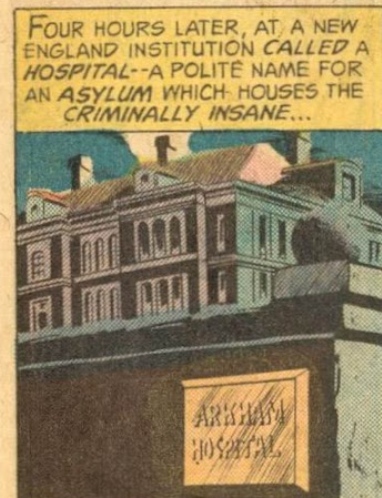
Arkham is mentioned for the first time in Batman #258, 1974, p.7
The origins of Arkham Asylum in the Batman comics date back to 1974, when it was first introduced as a hospital. However, a revealing caption makes it clear: it is merely “a polite name for an asylum which houses the criminally insane.” This unsettling duality sets the stage for a gripping narrative filled with tension and intrigue.1
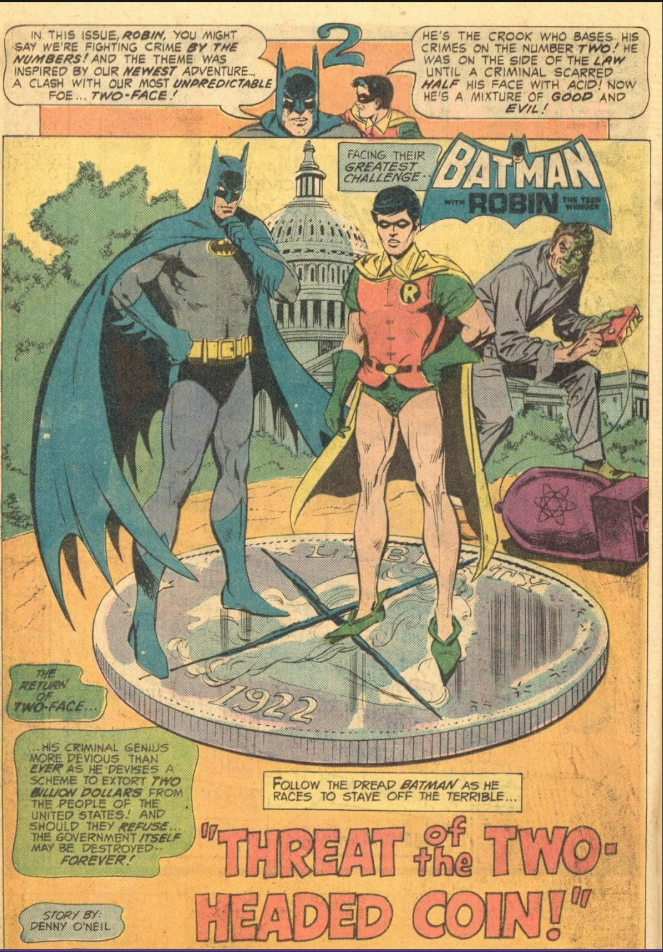
The description of Two-Face appears right on the second cover page of Batman #258, 1974.
The story kicks off dramatically with the shocking escape of Two-Face, also known as Harvey Dent, from Arkham Hospital. The very cover-page captures the reader’s attention, describing Two-Face as “the crook who bases his crimes on the number two! He was on the side of the law until a criminal scarred half his face with acid! Now he’s a mixture of good and evil!”2
As the plot thickens, our heroes, Batman and Robin, spring into action, racing against time to recapture Two-Face. His escape from Arkham was orchestrated by a renegade military general named John Harris, who believes “the nation is going to the dogs!” Disillusioned with the current state of affairs, Harris devises a chaotic scheme to hold Washington D.C. ransom using an atomic bomb, enlisting the twisted talents of Two-Face in his perilous plot.
As with every Batman comic from that time, the story ends with the successful detention of Two-Face by Batman, with your usual shenanigans of ”POW!,” “Bam!” and “KA-PAW!”
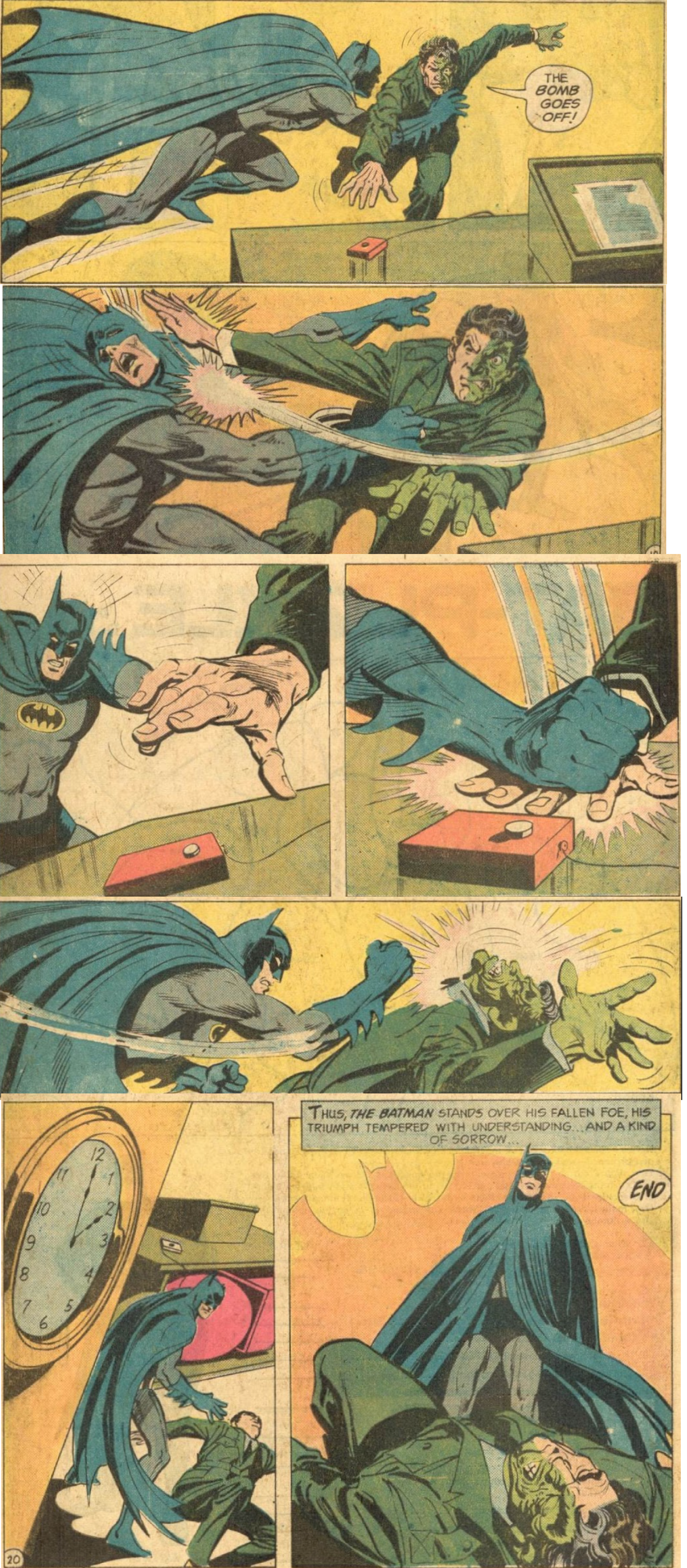
From Batman #258, 1974, pp. 19-20.
So, what was really going on during this time that might have bled into the most escapist form of reading, found in Batman’s comic book adventures?
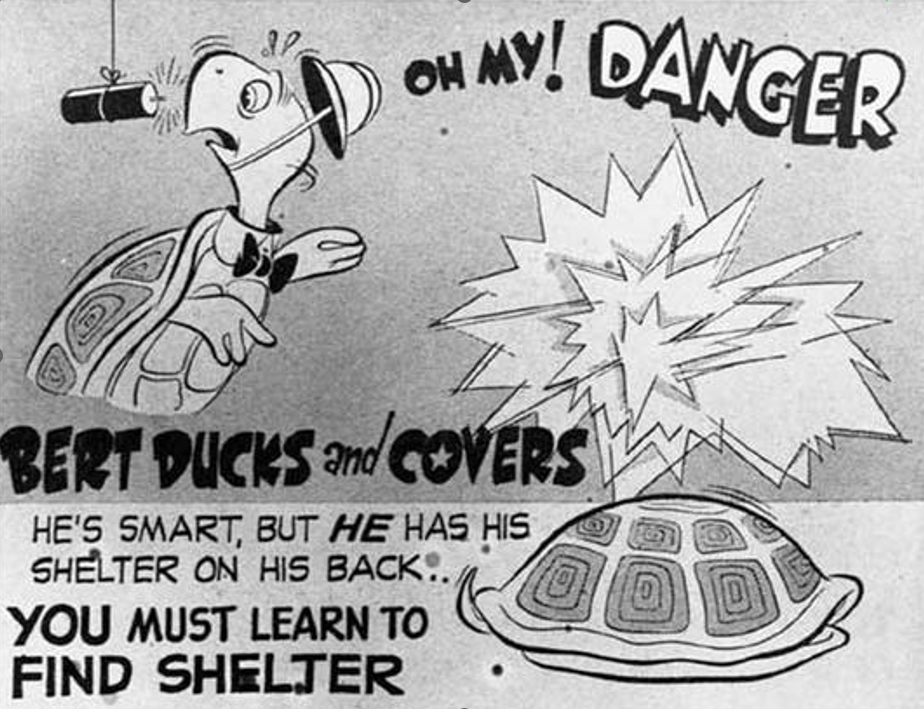
Take a look at this cute 1951 national defense film aimed at educating civilians on how to take cover during a scenario of nuclear bombing. Go to https://www.youtube.com/watch?v=LWH4tWkZpPU or look for director Anthony Rizzo’s Duck and Cover, 1951, Federal Civil Defense Administration, Washington, D.C.
Layered within this debut issue of Arkham is the context of the Cold War, a period significantly shaped by the aftermath of World War II and the lasting impact of the atomic bombings of Hiroshima and Nagasaki. Following these events, the United States and the Soviet Union emerged as superpowers. However, rather than uniting the world, they fostered a fierce rivalry that defined the era. This conflict took on an ideological dimension, pitting American capitalism and free markets against Soviet communism. Although direct military confrontations between the two superpowers were rare and the conflict primarily manifested in technological advancements and competition for influence in countries around the globe, the constant threat of nuclear escalation cast a dark shadow over society and fueled widespread national paranoia throughout the duration of the Cold War.3
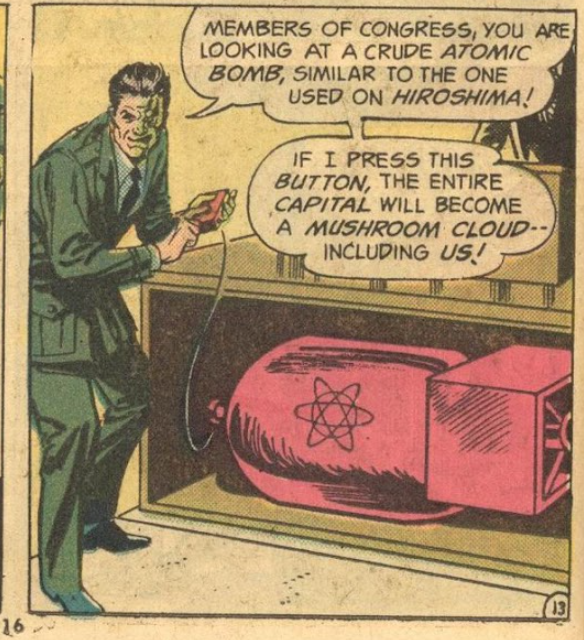
from Batman #258, 1974, p.16
Indeed, in this specific comic book, there are several panels that include explanations on how nuclear bomb works and mentions of Hiroshima.
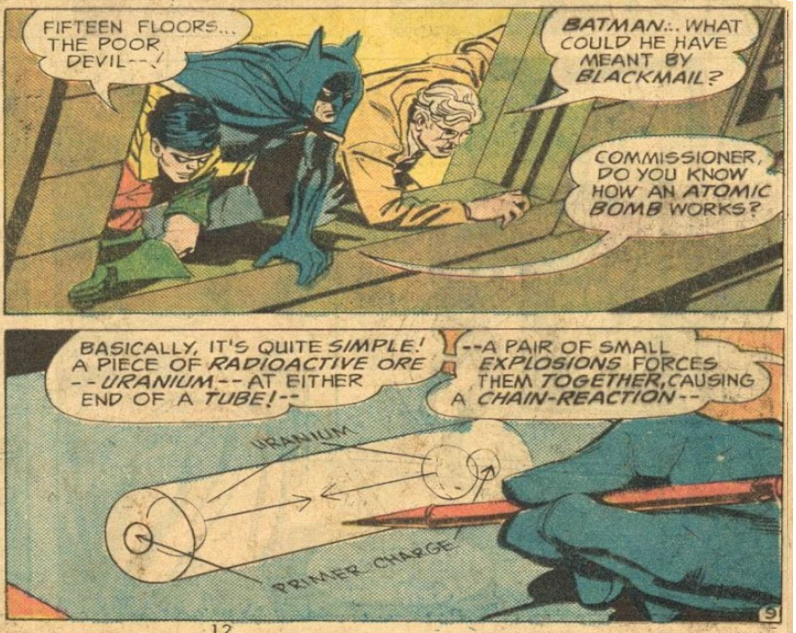
from Batman #258, 1974, p.9
What probably triggered this nuclear panic we are witnessing in this comic was the collapse of the so-called “détente”—a fancy French word for “let’s not blow each other up,” crafted in the early ’70s by Nixon and Kissinger. They thought they could keep the nuclear arms race from becoming a full-blown game of nuclear chicken, especially when the Soviet Union caught up with the U.S. in the atomic arms department. However, after Watergate and Nixon’s resignation in 1974, the détente started to crack and the threat of nuclear escalation was back to haunt the people.4
In the popular imagination of this era, the concept of “villains” turned into a real blockbuster of paranoia. No longer just the menacing foes lurking beyond the borders with their nuclear arsenal, but also “traitors from within”—such as double agents and Soviet sympathizers.5 Although this Batman comic does not mention Soviet influence, it offers a two-for-one deal on villainy: a nuclear threat paired with ordinary traitors. Yes, in plural, as not only General Harris is in on the scheme but also a side character that appears on only few panels.
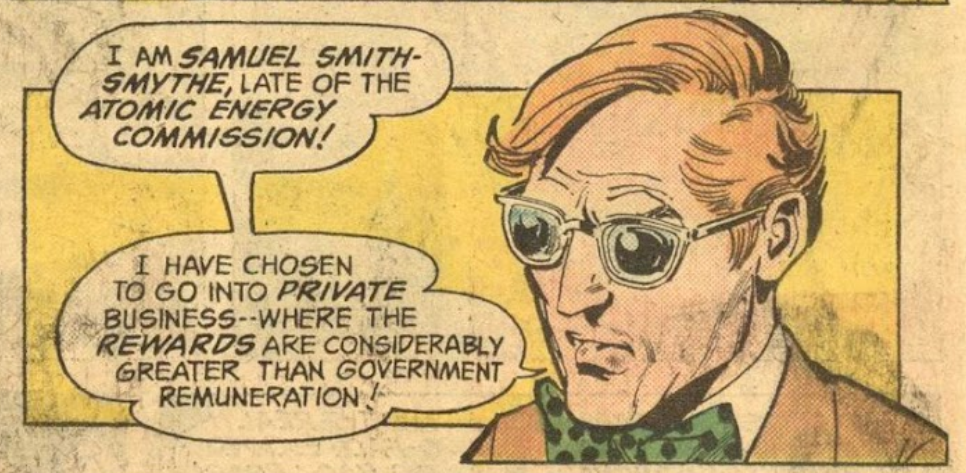
from Batman #258, 1974 p.7
Enter Samuel Smith-Smythe, a former member of the Atomic Energy Commission.
Disillusioned by the government’s meager salaries, forsakes his position for the allure of private enterprise, chasing after greater profits.Joining forces with the rogue General Harris, Smythe grants him access to nuclear bombs and spring Two-Face to extort the very government that once employed them both. Coming out on the heels of the Watergate scandal, we can also understand why this is the story the comic chose to tell us. The same summer America learned that the highest officials in the land—White House aides, FBI, CIA, even the President’s personal lawyer—could betray everything for loyalty, power, or a better deal. No Kremlin required. In 1974 the scariest enemy wasn’t wearing a hammer-and-sickle pin; he was wearing the same suit and tie as the American people trusted with the ultimate weapons.
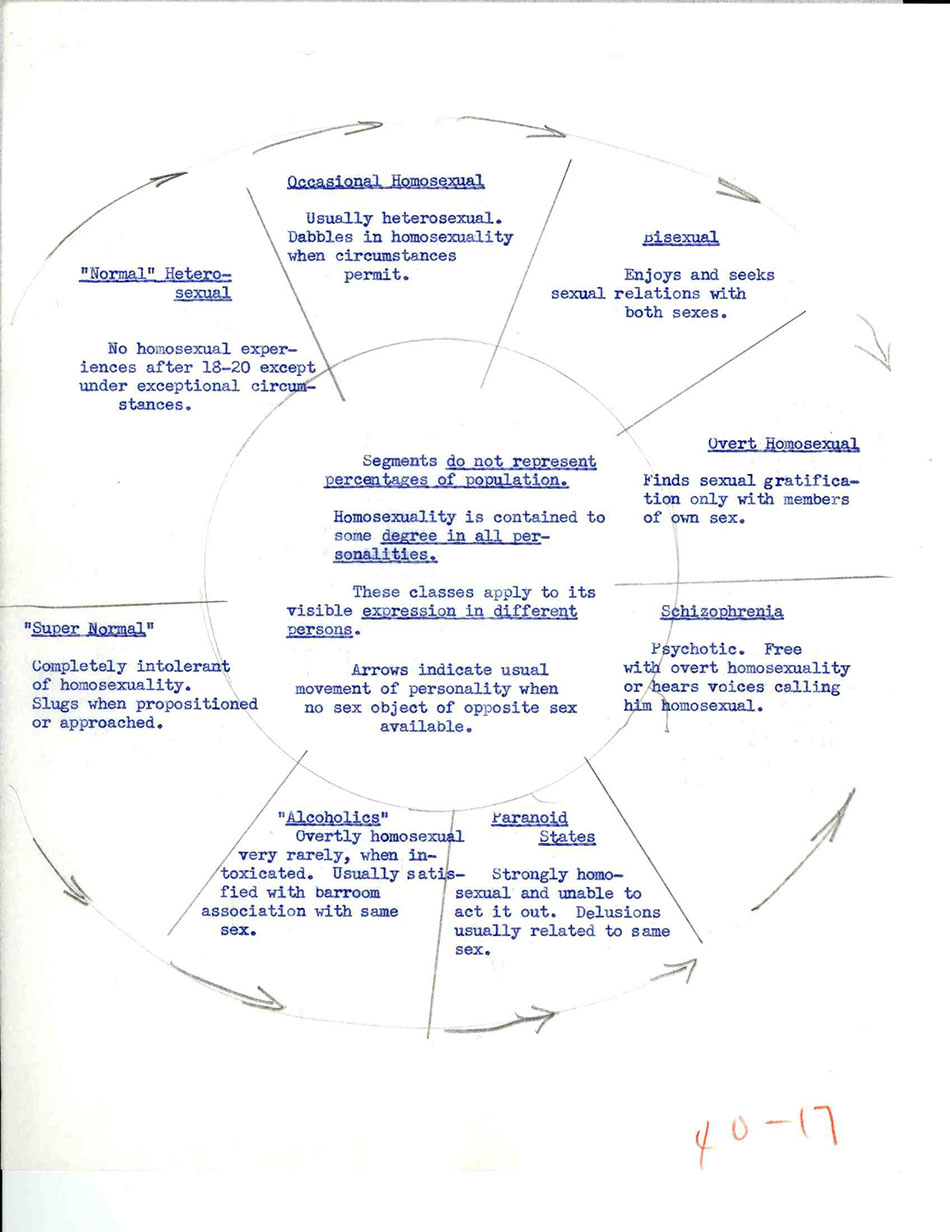
The “Lavender Wheel” was an exhibit that psychiatry professor George Raines used to teach at Georgetown University during these years. He submitted it to the Congress during in the 1951 Hoey Comittee that sought to detect homosexuals (Records of the U.S. Senate, RG 46).
Turns out that plot twists weren’t just the realm of DC Comics—politicians were crafting their own high-stakes dramas too.
Take Senator Joseph McCarthy, for instance. In the early years of the Cold War, he spearheaded a gripping “witch hunt” that could give Batman’s rogues gallery a run for their money. His mission? To sniff out alleged communist subversives like a bloodhound on a scent trail, all while leaving behind a legacy that would haunt the nation long after the 1950s faded into history. “Communist subversives” ended up being a catch-all label that included a unique group: homosexuals. Back then, they were not just considered socially awkward but were actually classified as having a mental disease and as a threat to the national security.6
This climate bled also into popular culture, and, in our case, superhero comics.
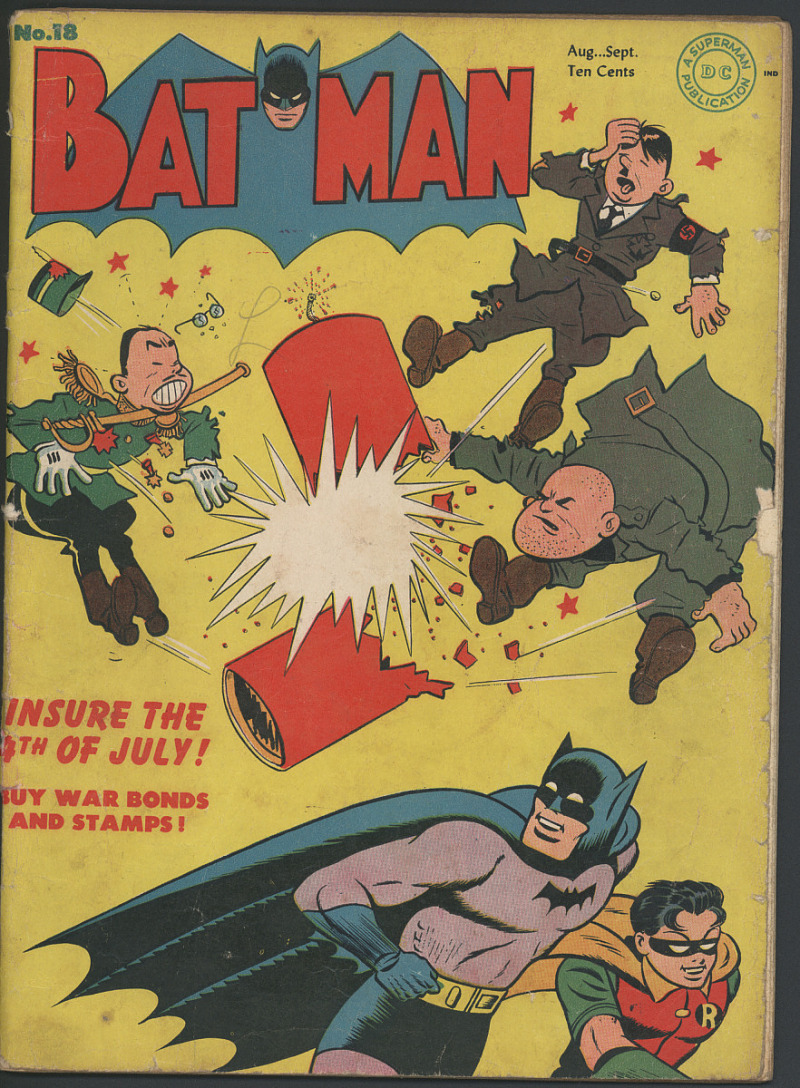
Batman #18, August-September 1943.
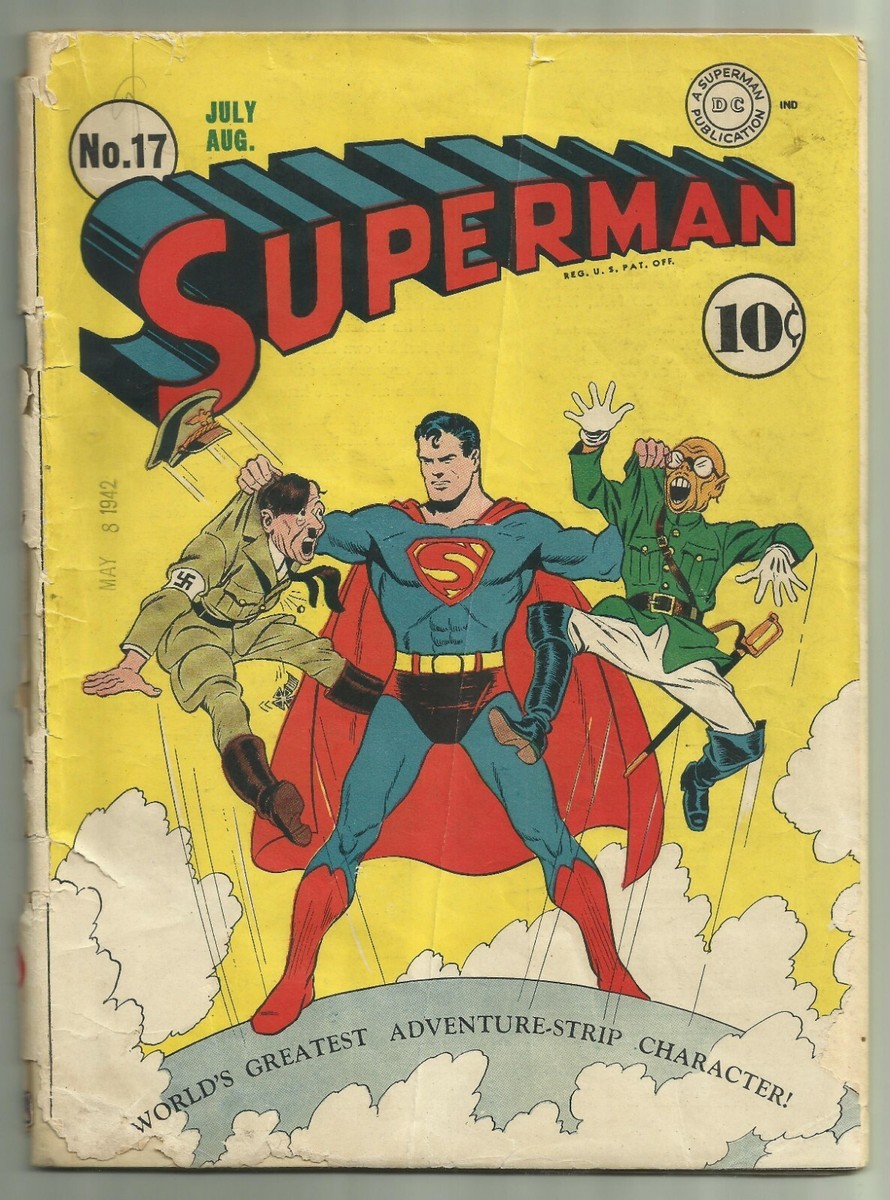
Superman #17 July-Augost 1942.
The iconic superhero figures such as Batman and Superman emerged in the United States during the late 1930s, embodying the ideals of strength and power characteristic of the American Dream. During this formative era, which lasted till the early 1950s, there was a notable proliferation of superhero narratives and an unprecedented flourishing of comic book publications. If you want to sound like an expert, all you should say is “The Golden Age of Comics,” a term that defines these “simpler” times, just before the Cold War made everything more complicated.
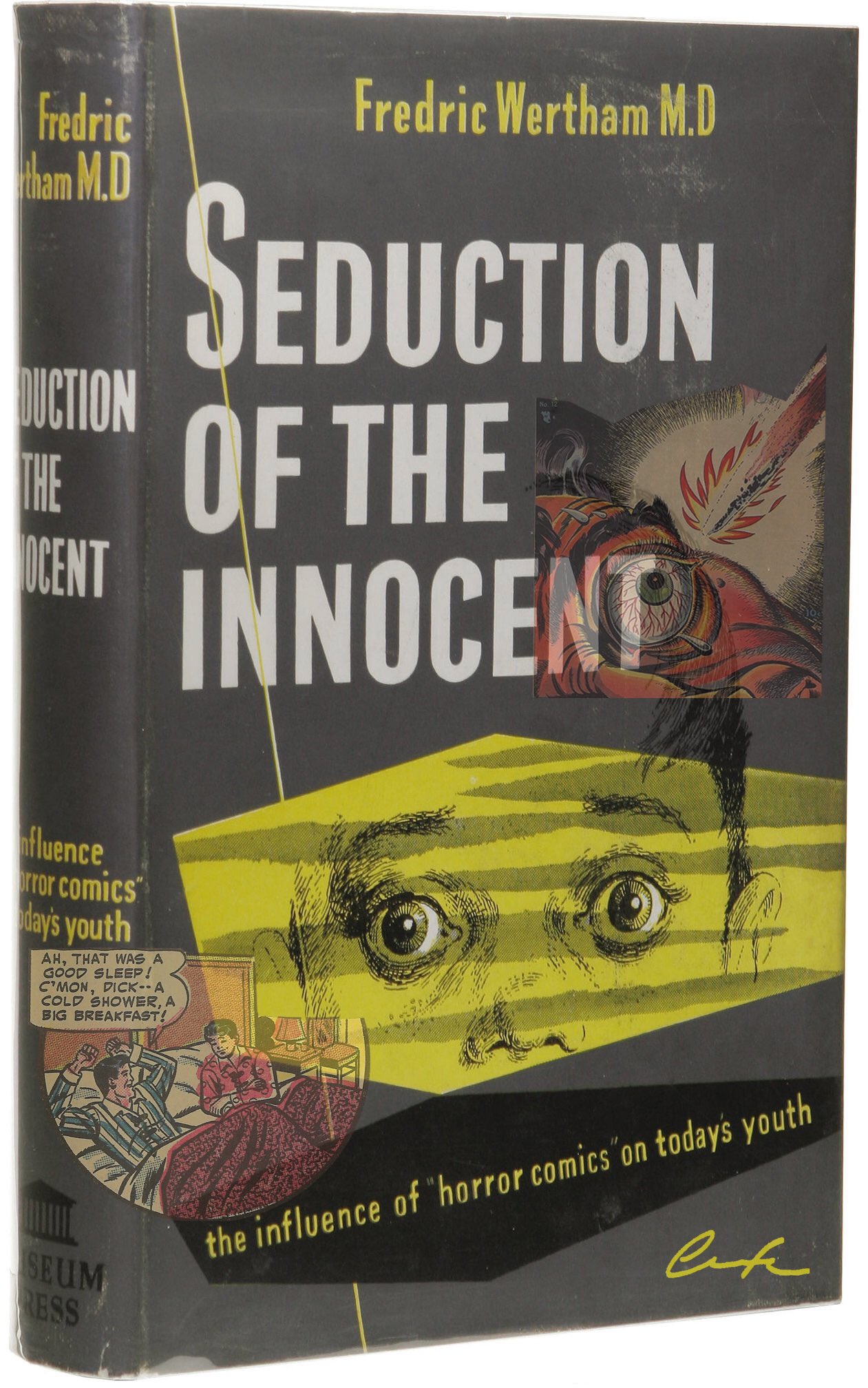
During that same time, concerns about rising youth crime led many people to blame comic books for this problem. As a result, the superhero comic industry faced a decline and came under intense scrutiny. Frederick Wertham, a German-American psychiatrist, published a book in 1954 called Seduction of the Innocent. In it, he argued that comic books were promoting violent behavior and encouraging unhealthy sexual attitudes among young people. 7
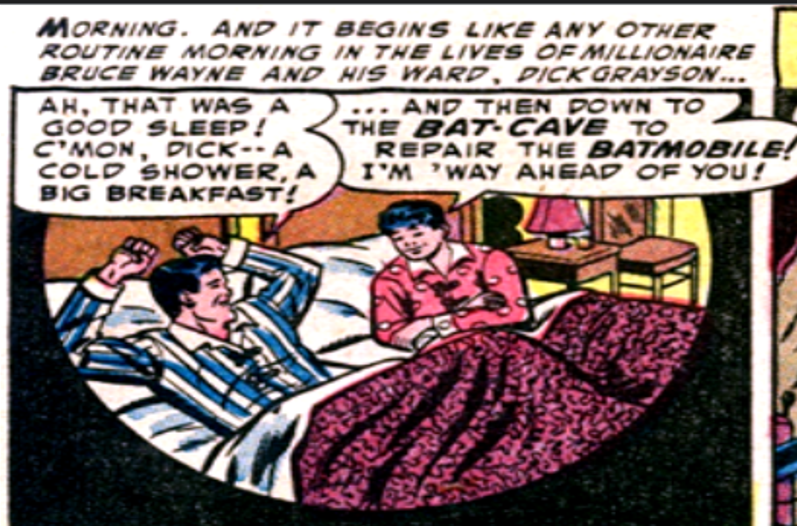
The offending panel Wertham talks about from Batman #84, 1954, p.1.
In particular, Wertham refers to Batman and Robin relationship, targeting a specific panel from 1954 issue of Batman (on the left) and writes: “The Batman type of story may stimulate children to homosexual fantasies, of the nature of which they may be unconscious.” For Wertham, the sexual connotations of the comic were obvious: “Only someone ignorant of the fundamentals of psychiatry and of the psychopathology of sex can fail to realize a subtle atmosphere of homoeroticism which pervades the adventures of the mature ‘Batman’ and his young friend ‘Robin.’”8
This book played a significant role in the criticism of comics during that time, so much that in response to the raising accusations, and in a self-censoring move, the comic books industry established its own code of conduct, that was then updated every decade.9
The fact that Wertham chose to speak out against comics, leveraging his authority as a psychiatrist (notice the “MD” by his name in a book about popular culture?) should also tell us something about the significant changes in public attitudes toward the mental health field that was taking place during the 1940s and 1950s.
In 1946, Albert Q. Maisel, a writer for Life magazine, published a groundbreaking exposé that revealed the deplorable conditions in state mental hospitals and asylums. His investigation ignited a nationwide conversation about the treatment of individuals with mental illnesses during that era.
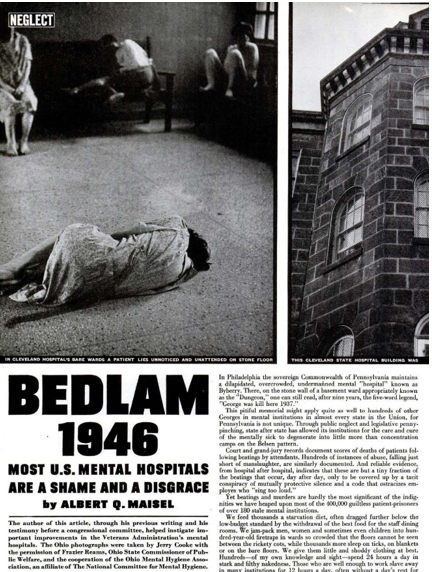
The cover of Maisel’s article in Life Magazine, from May 6, 1946.
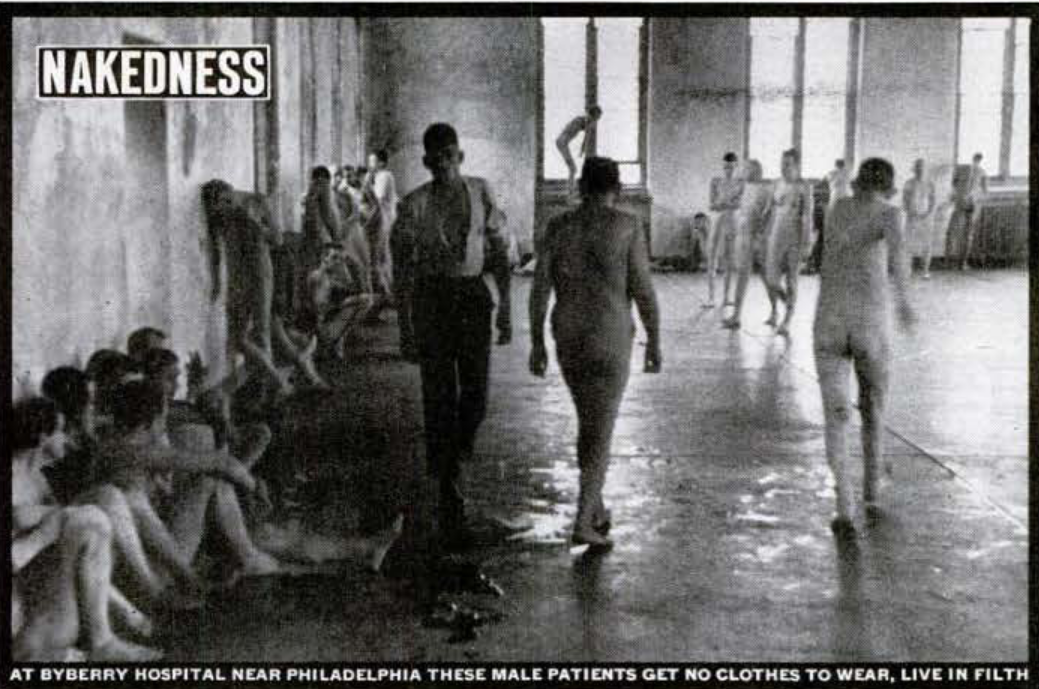
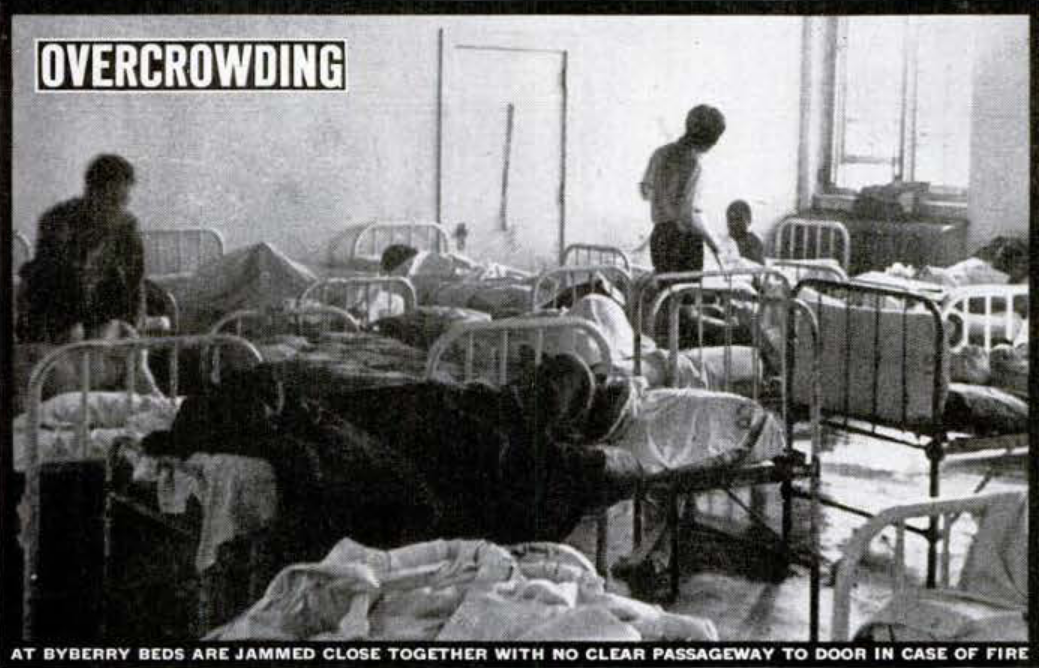
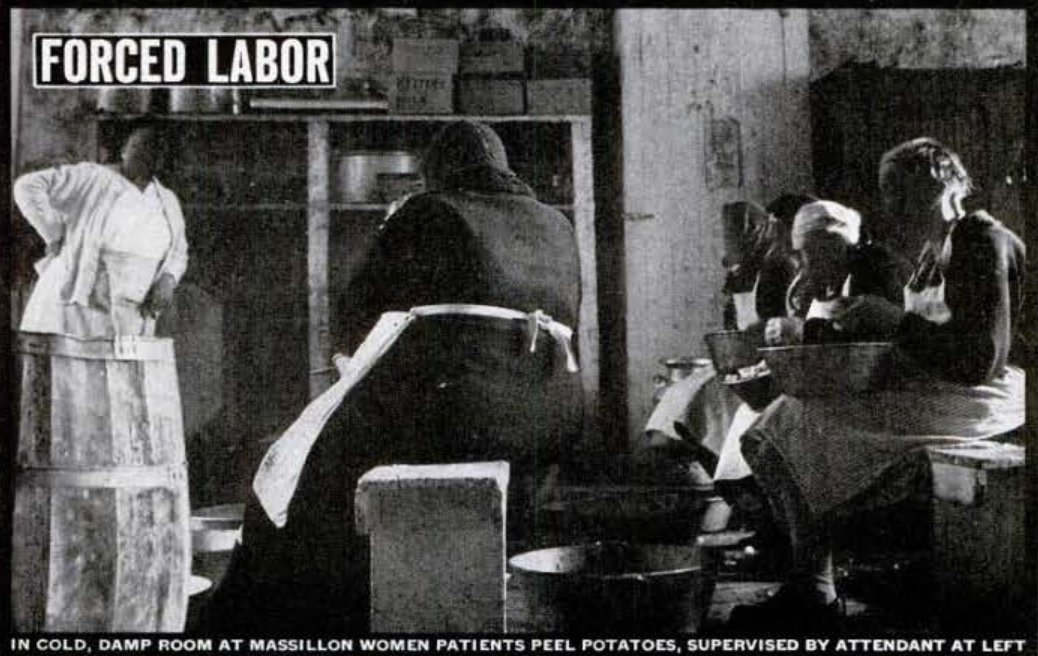
The above picture on the right, taken from Maisel’s article, shows a visibly emaciated woman, abandoned and left to suffer, her frail figure and distended abdomen embodying the despair that many experience daily. One of the most harrowing revelations in Maisel’s article is his stark comparison of U.S. mental health institutions to Nazi concentration camps. Next to it, I’ve compiled two pictures from the liberation of Auschwitz that circulated ever since 1945. By evoking these pictures and connections, Maisel powerfully argued that “through public and legislative penny-pinching, state after state has allowed its institutions for the care and cure of the mentally ill to degenerate into little more than concentration camps on the Belsen pattern.” 10
-
It seems clear now why the thoughts of Arkham Asylum and Auschwitz are not merely provocative—they are essential for understanding the broader implications of how American society thought about these institutions.


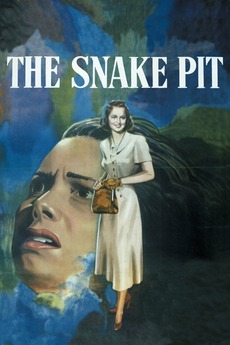
The poster for the 1948 The Snake Pit film

a scene from the film where the main is character getting ECT involuntarily
Maisel was not alone in his criticism. In 1948 the film the snake pit came out and told the real-life story of Mary Jane Ward as an institutionalized patient from 1931 to 1937. The movie showed the viewers all kinds of experimental somatic treatments: insulin coma therapy, Metrazol shock, electroconvulsive therapy (ECT), hydrotherapy—and how it was applied on mass scale without the patients’ informed consent and sometimes with little understanding of why (or whether) they worked. 11 The film garnered critical acclaim and increased public awareness and outcry against state mental hospitals and asylums. Civil rights movements started emerging, fighting to ensure that individuals with severe mental illness had the right to be treated in the least restrictive environments available.
.gif)
1955 Advertisement for Thorazine as replacing electroshock therapy. in Mental Hospitals, Vol. 6, No. 12.
1954 was a big one. Not only Wertham published his book in which he condemns comic genre to hell, but also the introduction of chlorpromazine (Thorazine) which was the first effective antipsychotic, prompted the American Psychiatric Association and other organizations to advocate for federal legislation that would facilitate higher rates of discharge from custodial settings.12
In addition, the case of the “laughing eel” came to haunt the headlines.
Louis Henry Ross has committed series of robberies during the year of 1920, and his victims often reported of his hysterical laughter while doing so, thus leading to his unique nickname by the press. Upon being caught in 1921, he was to receive a six to ten year prison term. However, following a mental breakdown during his first two years in prison, the judge declared him insane and put him in Farview, a rather new state hospital in the American landscape at Pennsylvania which opened its doors in 1912 and was dedicated for the criminally insane. Ross had lived in this institution, never receiving any therapy of any kind. Even when he did improved on his own and seemed, by the attendants as “pleasant, coherent and relevant” and “normal in every respect,” his release was never recommended and even his pleas for examination or parole hearings were denied.In 1954 he tried to escape and manage to get to attorney office and arranged for a lawsuit. The judge ordered his immediate release, saying that Farview “would necessarily condemn a patient for life with no hope of returning to society.” Upon his release in December 9th, headlines exploded, announcing the release of perfectly sane person from unjust state mental facility after being trapped there for over 20 years.1
-
For a more detailed account of the Ross case, see Tyler Stump, “Louis ‘The Laughing Eel’ Ross and the Road of No Return: Incarcerating the ‘Criminally Insane,’” Nursing Clio (blog), June 27, 2019, text Tyler Stump, “‘Road of No Return’: Farview State Hospital,” Pennsylvania History: A Journal of Mid-Atlantic Studies 88, no. 2 (2021): pp. 217-219; “Comth. ex rel. Ross v. Dye,” 488; Anne E. Parsons, From Asylum to Prison Deinstitutionalization and the Rise of Mass Incarceration after 1945 (The University of North Carolina Press, 2018) p. 49. Newspaper photo from text “Laughing Eel Surrenders,” Pittsburgh Post-Gazette (Pittsburgh, PA), November 19, 1954. ↩
It’s hard not to look at the “Laughing Eel,” his escape from hospital for the criminally insane and his official discharge, without thinking about a very particular character from the Batman comics that is very much the embodiment of criminal insanity, mad laughter and having a knack for succesful escape:
The Joker.

Cesar Romero as The Joker in 1966’s television show of Batman.
Yes, it is time we talked about him a little.
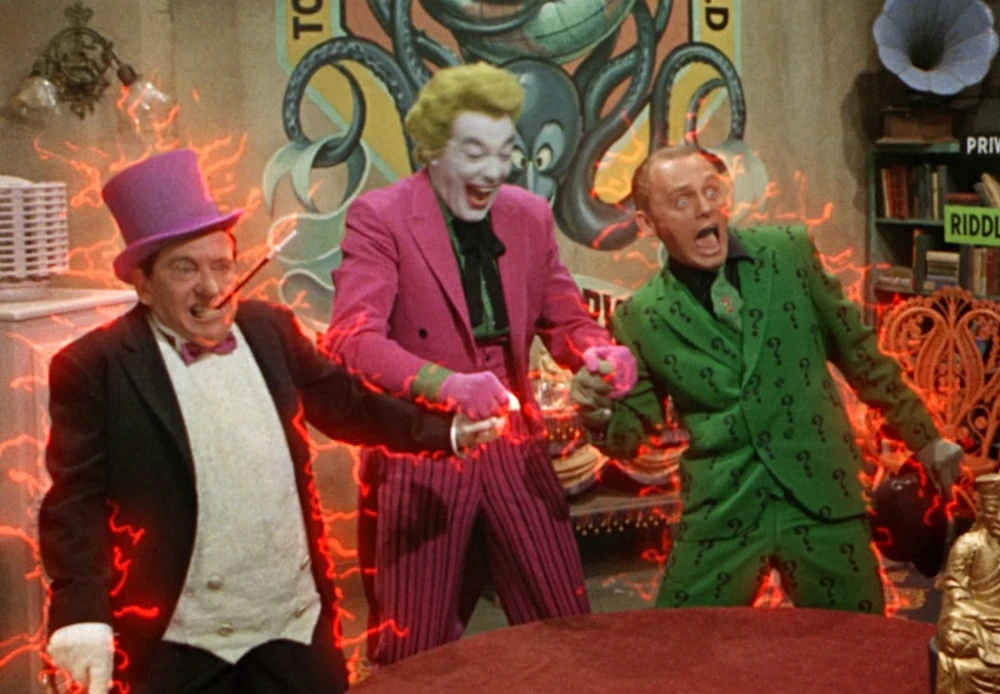
The Joker’s famous lethal buzzer in 1966’s Batman show.
After Wertham’s book and the establishment of the Comics Code Authority in 1954, editors of Batman comic books adhered to the principles of banning gore, innuendo and excessive violence, stripping Batman of his menace and transforming the Joker into a goofy, thieving trickster without his original homicidal tendencies. Joker, in fact, almost completely disappeared from the landscape of Batman comic books during the 1960s, when an editor who disliked the Joker became the main editor of the comic series. The campy 1966 Batman tv series featured Joker in his most clownly goofiness, complete with acid squirting flowers, trick guns and lethal joy buzzers.13
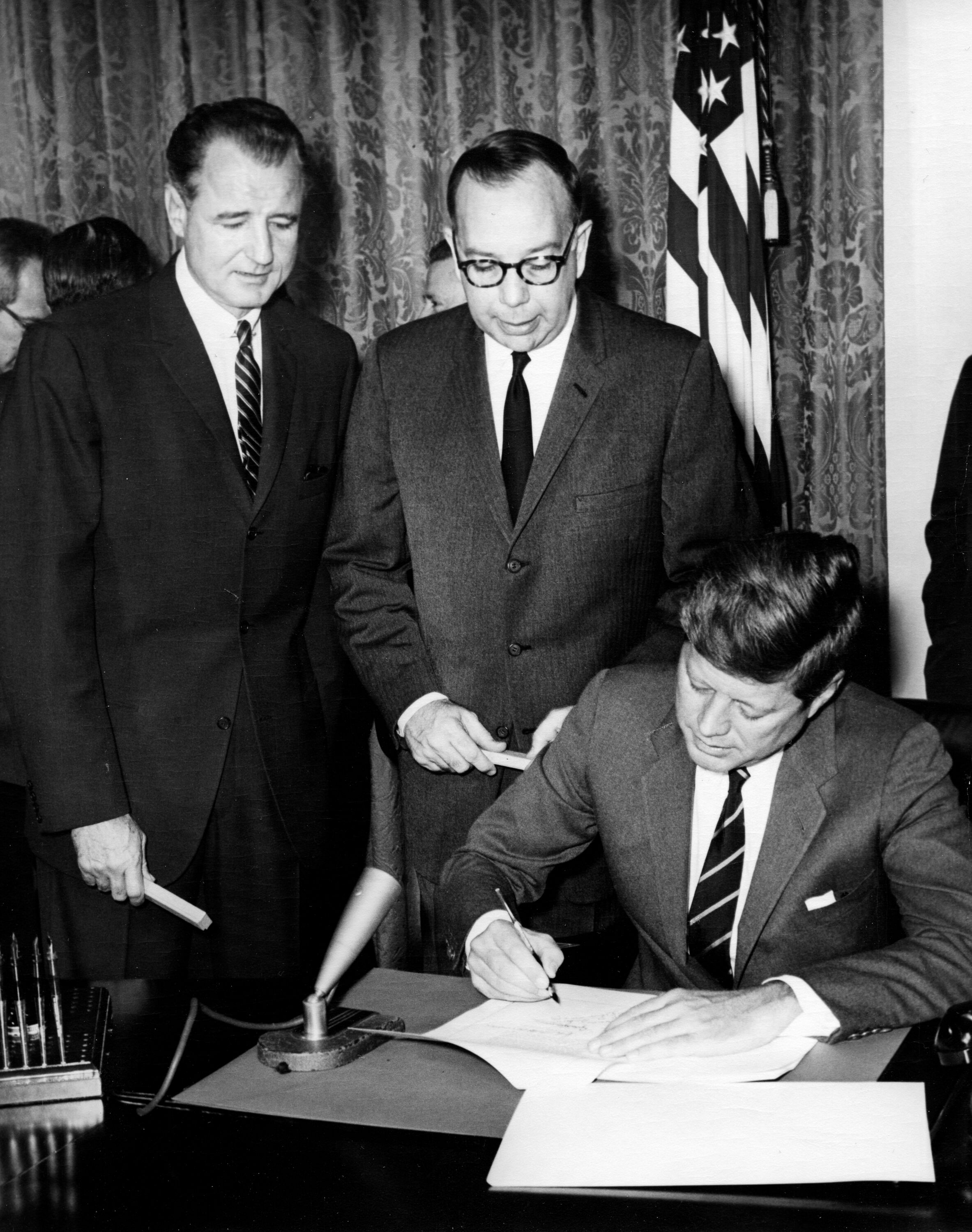
President John F. Kennedy Signs the Mental Retardation Facilities and Community Mental Health Center Construction Act. Photograph by Cecil Stoughton. White House Photographs. John F. Kennedy Presidential Library and Museum, Boston.
During that same time federal legislation started to take root. The 1963 Community Mental Health Act funded community-based centers offering inpatient/outpatient care, partial hospitalization, emergency services, and education. 14 Next followed the Medicare and Medicaid in 1965, which shifted institutional funding from states to the federal government, encouraging reduced reliance on large psychiatric hospitals.15
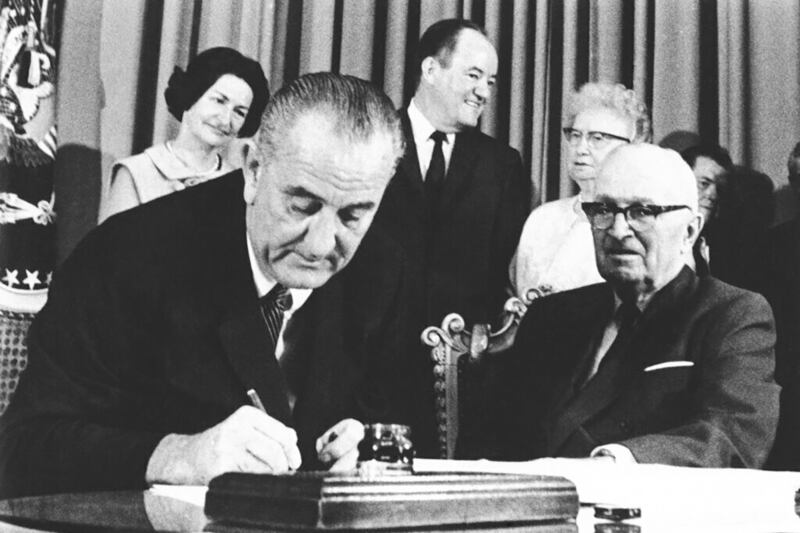
President Lyndon B. Johnson signs the Medicare bill in Independence, Mo., July 30, 1965. At right is former President Harry Truman.
The 1966 Lake v. Cameron ruling established the “least restrictive setting” principle, requiring discharge to less restrictive environments when possible. Combined with stricter admission criteria, these changes made hospitalization much harder to access. As a result, many individuals with severe mental illness were discharged without adequate community support, leading to widespread homelessness, arrests, and premature deaths. Psychiatrist Darold Treffert’s 1973 phrase “dying with one’s rights on” criticized laws that prioritized civil liberties over safety and treatment needs. This trend culminated in the 1975 Supreme Court case O’Connor v. Donaldson, which ruled that nondangerous individuals capable of surviving safely outside (alone or with help) could not be confined against their will. 16
So, we’ve just done with this historical crazy train called deinstitutionalization (and good luck saying it without your tongue taking a vacation!) —which is just a fancy term for the shift from state mental hospitals and asylums to community mental health centers.
This brings us full circle to where we started: the first Batman’s iconic 1974 issue that introduced Arkham Hospital for the criminally insane.
In particular, this is also the moment when General Harris breaks free Two-Face and they both leave behind a very angry Joker.
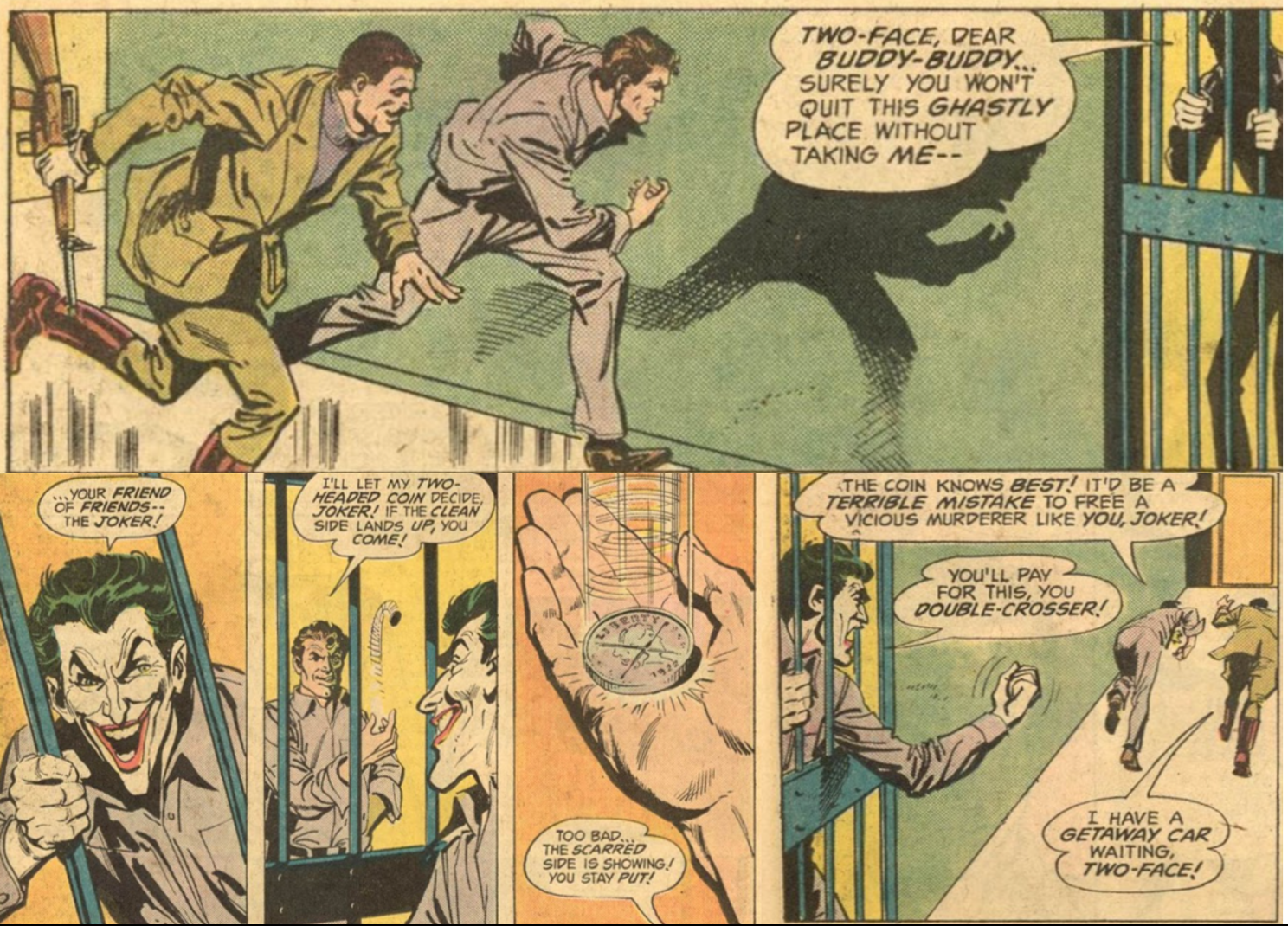
Batman #258, 1974, p.8.
Fast forward a few months to…
May 1975,
DC Comics made a very bold move. After two decades of Joker almost disappearing and beingmore of a goofy harmless prankster rather than a serious criminal and threat to Batman-
The comic company decided on launching a dedicated series all for him.
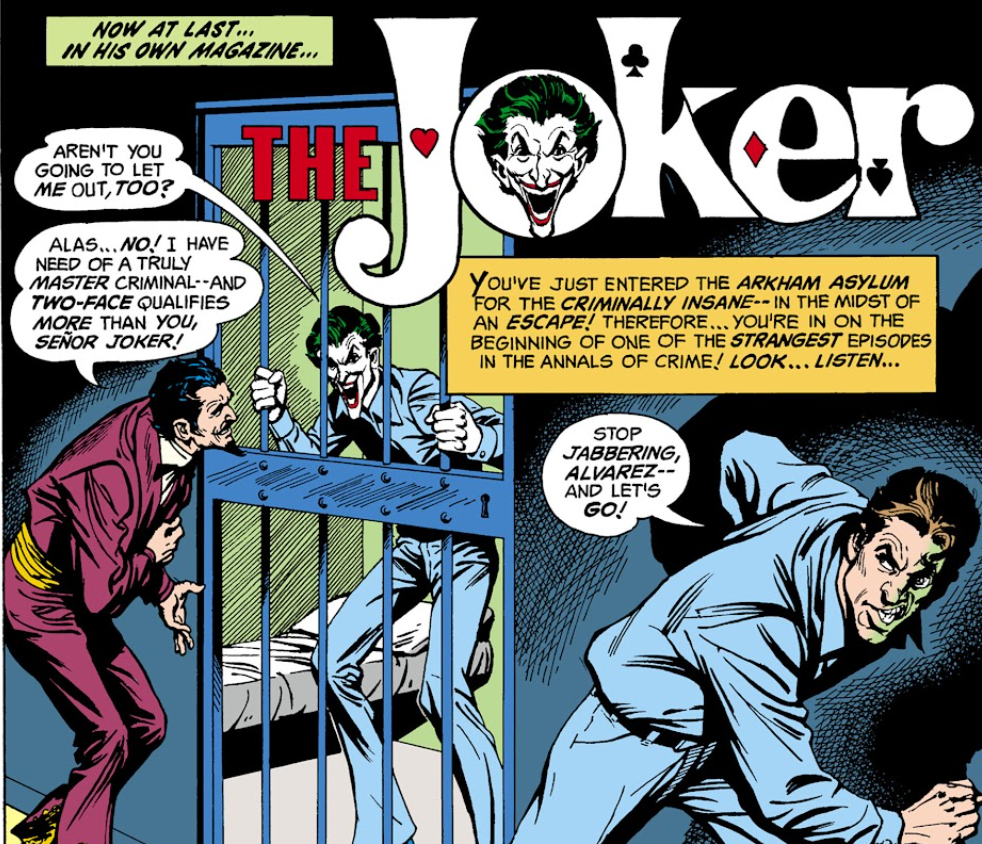
from Joker #1, May 1975
The series debuted right on the heels of General Harris’s dramatic escape with Two-Face, leaving the Joker behind in a fit of fury and revenge. This pivotal moment marked not only a significant turning point in the Joker’s storyline but also an intriguing connection to Arkham Asylum. While Batman #258 initially associated Two-Face with Arkham Hospital, the first issue of the Joker series boldly announced, “You’ve just entered the Arkham Asylum for the Criminally Insane - in the midst of an escape! Therefore… You’re in on the beginning of one of the strangest episodes in the annals of crime! Look… Listen…”17
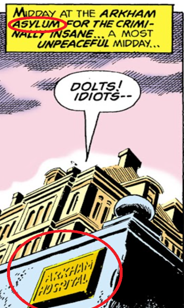
from Joker #2, July 1975, p.2
DC Comics kept using Arkham as hospital in some comics and asylum at others, sometime in the very same comic. In Joker #2, for example, the captions announced “Arkham asylum for the criminally insane” but the signage in the panel’s drawing says “Arkham Hospital.” After yet again another escape of Joker, the superintendent of the Asylum shouts at the staff: “How could you be fooled by that? This is the FIFTH TIME you’ve let THE JOKER escape! Well, there won’t be a sixth!” 18
Indeed, time after time Joker is either breaking free by himself -
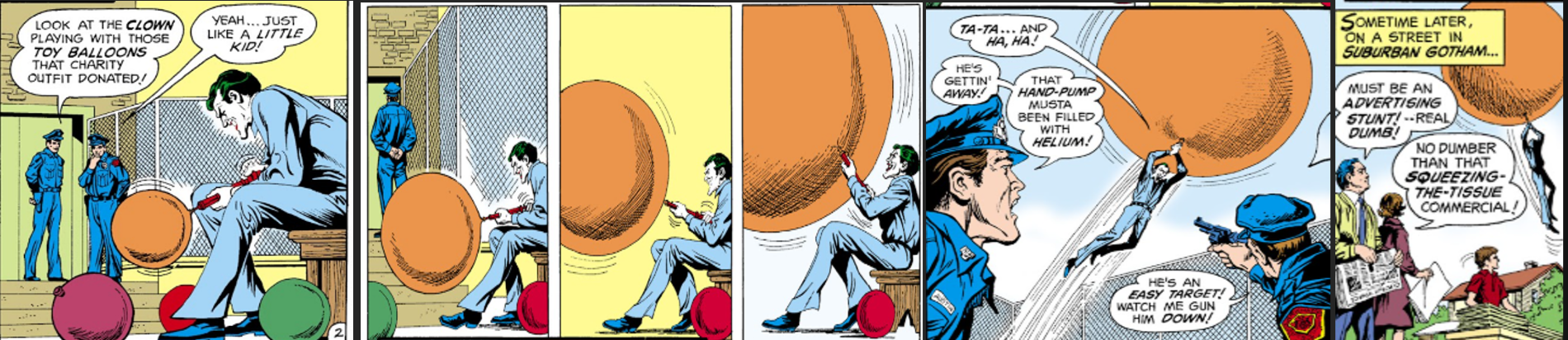
from Joker #1, May 1975, pp.2-3
Or with the help of outside collaborators (as in Joker#2, with Weeping Willy).
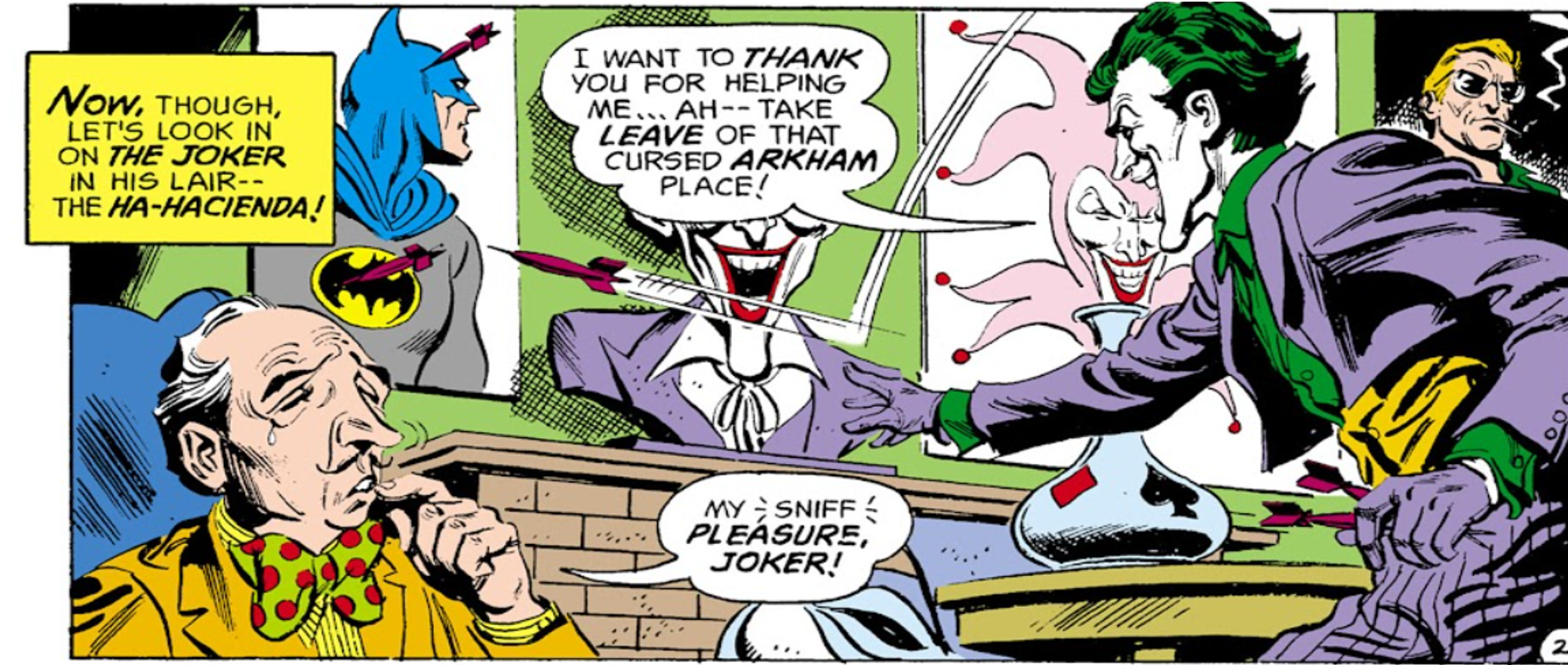
from Joker #2, July 1975, p.2
As we can see, while the 1970s Batman’s tales often kick off with the release of patients from Arkham Hospital/Asylum, these rarely reflect the reality of effective treatment, such as the use of antipsychotic medications, or the legal reforms aimed at preventing the indefinite confinement of mentally ill individuals. The inability to confine dangerous “insane” criminals keeps resurfacing in these comics as a looming threat to society
It took until 1980 for Arkham to officially become Arkham Asylum, rather than being referred to as “Arkham Hospital” throughout the 1970s, but the core-narrative never changes: no one gets out of Arkham because of a successful treatment, psychosurgery or antipsychotic drugs, and followed with rehabilitation back to society; and neither do the new, civil-rights informed laws that forbid involuntary confinement of mentally ill people show up in these comics. This stagnant portrayal begs the question… or rather… the riddle:
Ridde me this:
In the seventies, real courts unlocked the mad—’No more cages!’ they decreed. Yet that same era saw Arkham rise, where the criminally insane never leave. What ties liberation’s dawn to fiction’s endless night? Why does my playground defy the law’s progressive light?
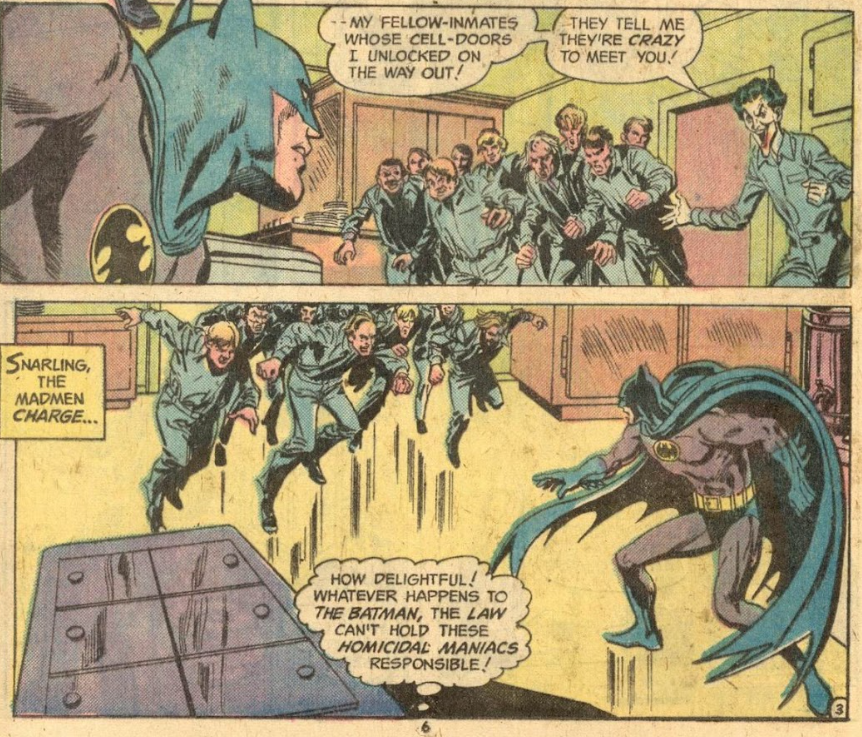
from Batman #260, 1975, p.6
Already in Batman #260 (February 1975), when Batman is fighting Joker in Arkham Hospital after yet another take-over of the inmates, Joker is portrayed thinking: “How delightful, whatever happens to the Batman, the law can’t hold these homicidal maniacs responsible!” 19
This is a critical commentary during a time when the notion of “danger to himself or others” was ruled in the high court. These same notions of the Joker keeps surfacing, as in the Joker #4, when he proudly tells his kidnappee:
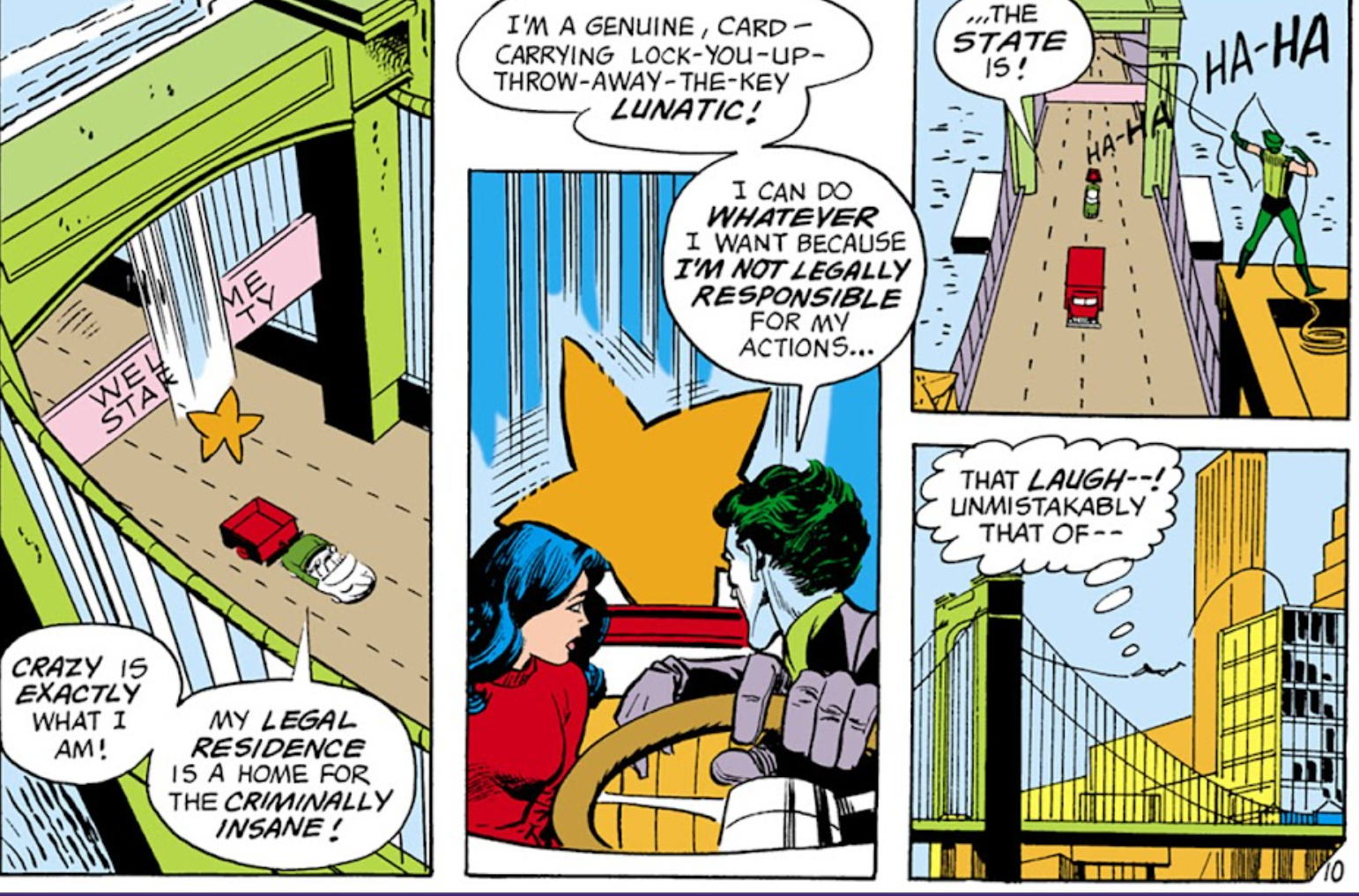
from The Joker #4, 1975, p.10
In these examples, the Joker discusses his rights as a mental patient and his accountability for his actions, reflecting the legal discussions of his time on mental health and the criminal system. This brings us to the murky waters of criminality, mental health, and the justice system.
The social welfare state of 1960s used to assist and care for individuals with substance abuse issues, sex offenders, people with disabilities and undocumented immigrants. However, when President Nixon took over office in 1969 there was a significant shift in how society addressed issues like drug use, crime, and poverty. Policymakers moved away from rehabilitative approaches and leaned toward tougher methods, such as increased surveillance, harsher punishments, coercive tactics, and even quarantine. As state asylums and mental hospitals closed, a new type of institutionalization emerged in the criminal justice system. When severe mentally ill patients couldn’t access community mental health centers, or get real treatment, they often time ended in the streets, which, in turn, led to them disturbing the public order and landing in jail. The criminal justice system, thus, took over the care of these individuals and focused less on diagnosing mental health issues and more on punishing law-breaking behavior. Ironically, since there was so much public discourse surrounding the civil rights of mentally ill people, police officers who arrested mentally ill people for nonserious offenses could not civilly commit them, so they opted for sending them to jail. 20
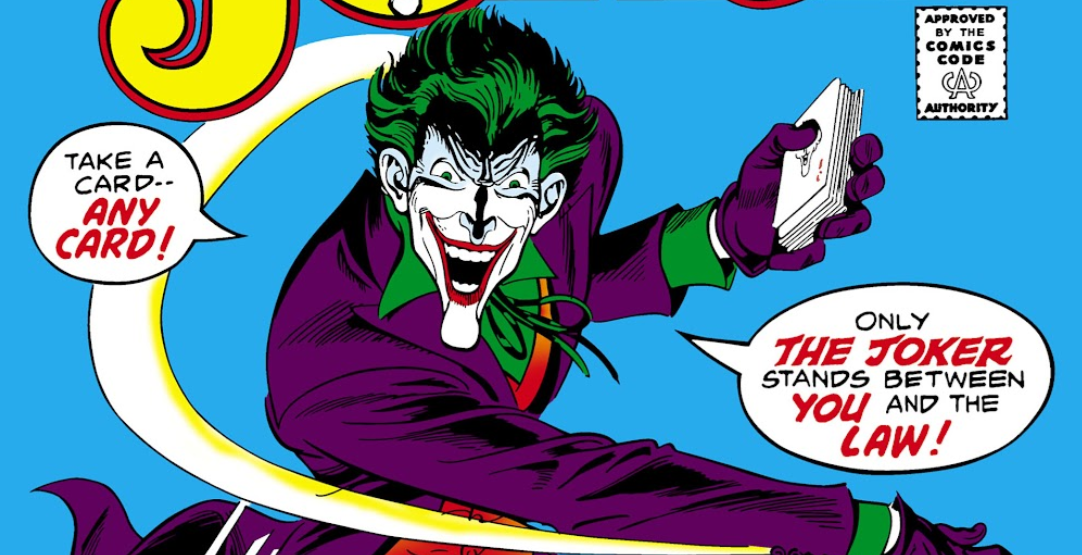
from The Joker #2, 1975, cover.
Not only were there movements for civil rights, but also movements for the rights of prisoners which sought to pass bills and statues such as “The Good Time Bill” which aimed to diminish the abolish minimum sentences for most male prisoners. Even just thinking about the name, we can clearly see how such attempted policies were portrayed in Batman comics: not a real chance of rehabilitation, but rather a “good time,” a real “home” which criminally insane people like the Joke can utilize to their advantage, not only to escape, but to turn to. In that same year, there was also a major event of riot in Attica’s prison, as the inmates took control of the facility. However, instead of demanding their release, they called instead for more rights and basic humanitarian conditions. An army of armed forces swapped the facility, ending up killing 41 inmates and guards. The mainstream media chose to tell a very different story, of which the prisoners had slit hostages’ throats to get their demands met before state troopers invaded. The whole event had led to increasing call for punitive rather than rehabilitative prisons. 21
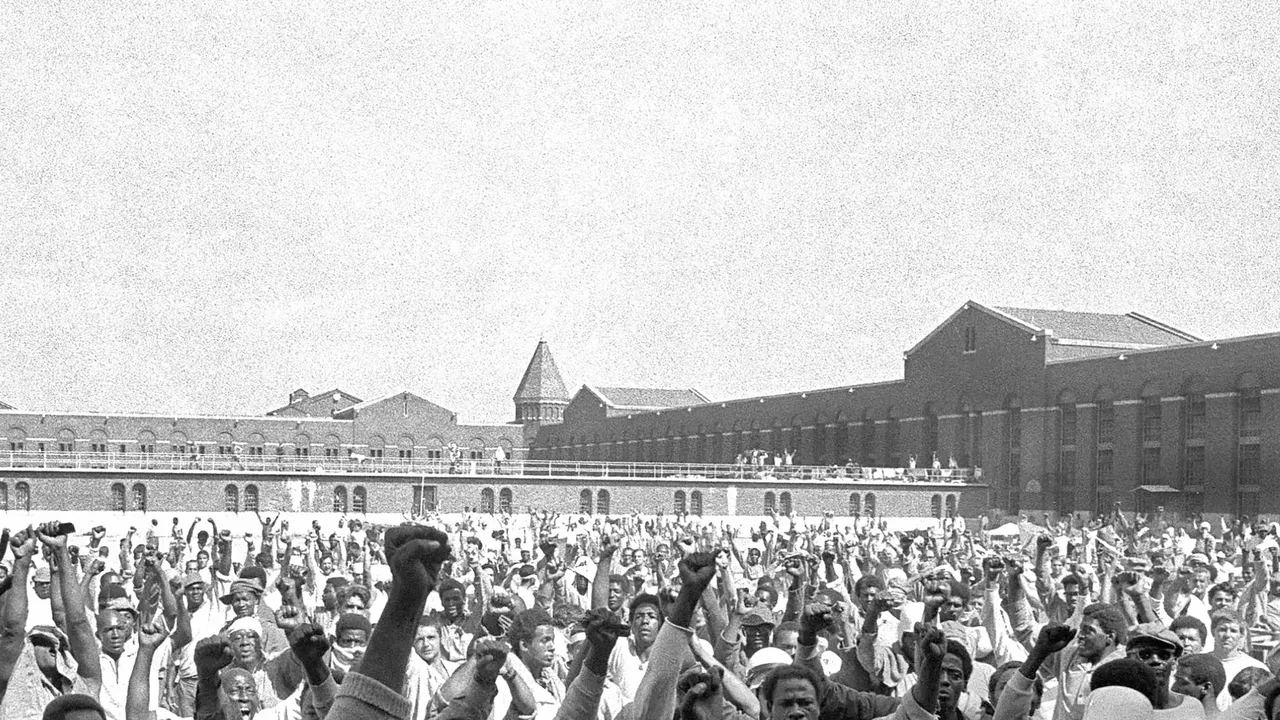

The 1971 prisoners riot in Attica prison, before and after.
And so it was that in 1971 not only the Good Time Bill was rejected, but a whole shift in mental health commitment laws started taking place, along with the public’s complete loss of faith in the welfare government programs in mental health and in prison system to rehabilitate individuals. 22 And if that wasn’t enough, the insanity defense also went through some major changes. The very same year of The Joker comic series launched, the Michigan Code of Criminal Procedure shifted from a verdict of criminal defendant as “not guilty by reason of insanity” to “guilty but mentally ill” which still allowed the court to sentence them to prison rather than a mental hospital.23 It’s been a long coming now, that the insanity defense was under great deal of legal debate and criticism, including calls for its abolition. Thus came the “guilty but mentally ill” to act as an alternative to an insanity acquittal: its incarceration component addressed public concerns about crime and safety and allayed uncertainty about the accuracy of psychiatric prediction, efficacy of treatment, and premature release into the general population. While it came under constitutional attack on the grounds of “the right to treatment” and “equal protection,” other states courts soon followed and embraced its approach. 24
This what leads some scholars, such as Parsons who I quoted all over here, to argue that deinstitutionalization was more of trans-institutionalization, as it didn’t truly eliminate confinement but rather transformed it—making it so that individuals with severe mental illness transitioned from mental hospitals into prisons, with occasional stop at the streets. While Batman’s comics reflect some vital questions about how society views those with mental health issues and the effectiveness of the criminal justice system, it still leaves us one great riddle:
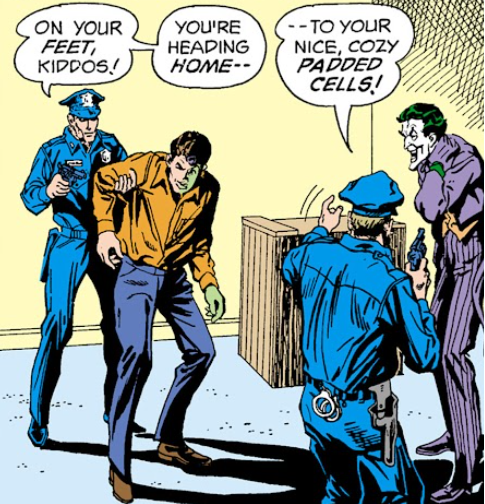
from The Joker #1, 1975, p.18
Why Do DC Comics choose to portray the Joker as the epitome of criminal insanity, the ultimate denizen of Arkham Asylum, despite compelling evidence pointing to his need for a traditional prison cell instead?
By the 1980s, even the morally ambiguous Two-Face, a character torn between good and evil, finds himself unjustly categorized alongside the Joker in that infamous asylum instead of receiving the mental health treatment he desperately needs to rehabilitate. Is this a mere plot device, or does it reflect a deeper commentary on justice, morality, and the very nature of sanity within Gotham’s chaotic landscape?
To conclude this exploration of Arkham Asylum’s shadowed halls, I argue that its establishment as a dedicated institution for the “criminally insane” was far more than a mere plot device—after all, why not simply send Batman’s rogues to ordinary prisons? Instead, Arkham served as a pointed commentary on the criminal justice and mental health systems of the mid-1970s, a time when deinstitutionalization was rapidly emptying state hospitals while public anxiety mounted over where the mentally ill—especially the dangerous ones—would end up.
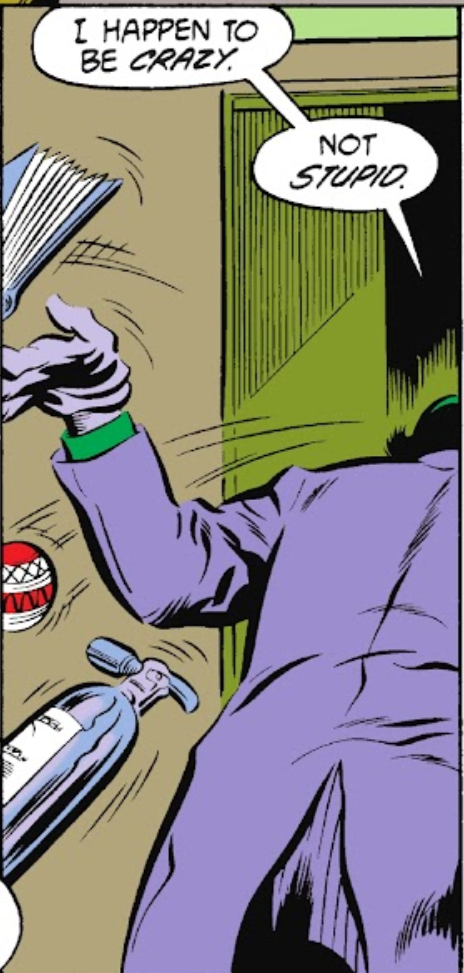
Figures like the Joker and Two-Face are not, in fact, insane in the clinical or legal sense. They meticulously plan their crimes, remain acutely aware of their surroundings, and stay firmly in touch with reality. The Joker, in particular, offers cynical meta-commentary on his own lack of responsibility, gleefully exploiting the system without even pretending to be detached from sanity—the state does that work for him by labeling him “criminally insane” and committing him to Arkham rather than prison. This revolving door of escapes and recommitments, vividly on display in The Joker’s 1975–1976 solo series, underscores a clear underlying message in DC Comics: such calculating, dangerous offenders belong in prisons, not therapeutic asylums.
This fictional critique matches perfectly the real-world fears of the era. The Supreme Court’s O’Connor v. Donaldson decision in June 1975 prohibited indefinite civil commitment of non-dangerous individuals, accelerating releases and exposing the shortfall in community-care funding. Meanwhile, growing backlash against perceived leniency in criminal insanity defenses—exemplified by Michigan’s new Guilty But Mentally Ill verdict that same year—reflected public alarm over tax dollars wasted on treatment for the unreformable and the risk of dangerous individuals being “unleashed” back into society.
Conclusion
From the shadowed gates of real asylums—evoking not just sanctuary but the horrors of indefinite confinement and stigma—to the fictional madness of Arkham Asylum, Batman comics have long served as a dark mirror to America’s evolving relationship with mental illness.
What began in the Cold War era with McCarthyism and Seduction of the Innocent fears, went hand in hand with depiction of post WWII, both the threat of nuclear annihilation and concentration camps on American land through asylums. Sweeping deinstitutionalization reforms promised to amend these, such as JFK’s 1963 Community Mental Health Act which promised community-based care over warehousing, culminating into the Supreme Court’s landmark O’Connor v. Donaldson ruling in June 1975: states could no longer constitutionally confine non-dangerous individuals who could survive safely outside, regardless of diagnosis or perceived need for treatment. This accelerated mass releases, exposing the gap between idealistic policy and underfunded reality—led to rising homelessness, incarceration, and societal fears.
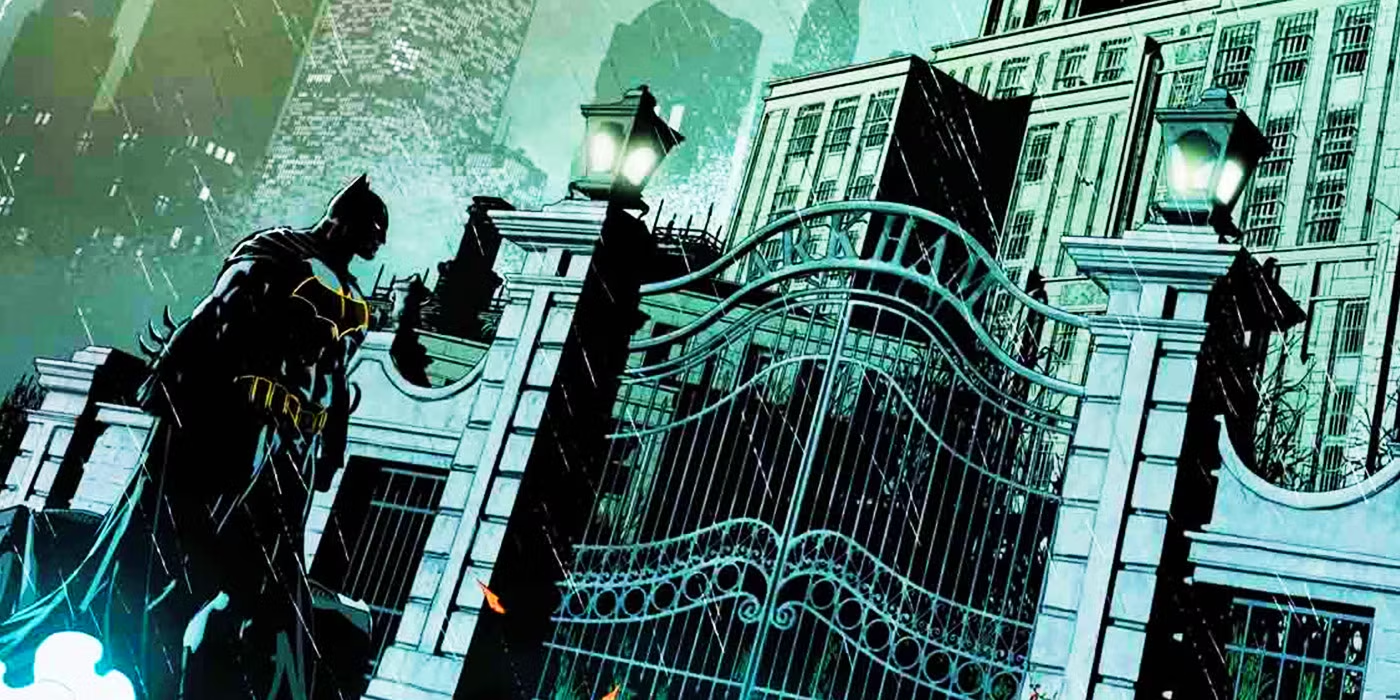
In this exact moment, DC Comics launched The Joker’s solo series in May 1975, reviving him under Dennis O’Neil as a gleefully homicidal maniac repeatedly deemed “legally insane.” His endless cycle—commit chaos, get caught, escape Arkham’s supposedly secure walls—embodied the very fears deinstitutionalization provoked: What happens when the truly dangerous “mad” are not safely contained? While civil commitment laws tightened to protect patient rights and mandate least-restrictive care for the non-dangerous, criminal insanity debates heated up. Michigan’s pioneering Guilty But Mentally Ill verdict that year addressed backlash against perceived leniency in Not Guilty by Reason of Insanity acquittals, emphasizing punishment alongside treatment and reflecting public anxiety over released offenders.
Arkham’s revolving door, then, was no mere plot convenience; it perpetuated stigma, warning of unreformable chaos in an era pushing for rehabilitation over isolation.
As a child dressing as Batman for Purim, captivated by the hero’s brooding justice, I never questioned Arkham’s gates—until connecting them to my grandmother’s Auschwitz survival and the word “asylum’s” dual meaning of refuge and prison.
These fictional portrayals didn’t just entertain; they reinforced cultural fears, distracting from the real challenge: building robust community supports post-deinstitutionalization.
In the end, the Joker’s laughter echoes a societal joke—prioritizing spectacle and punishment over nuanced understanding of mental health and justice.
Bibliography
Primary Sources
-
“Comth. ex rel. Ross v. Dye,” The Pittsburgh Legal Journal 102 (1954): 486-488.
-
“Laughing Eel Surrenders,” Pittsburgh Post-Gazette, November 19, 1954.
-
“The Lavender Wheel.” 1950. Records of the U.S. Senate, RG 46. https://www.archives.gov/publications/prologue/2016/summer/lavender.html
-
Finger, Bill. Batman #84. DC Comics, June 1954.
-
Litvak, Anatole, dir. The Snake Pit. Twentieth Century-Fox, 1948.
-
Maggin, Elliot S. “A Gold Star for the Joker.” The Joker #4. DC Comics, December 1975.
-
O’neil, Dennis. “The Threat of the Two-Headed Coin.” Batman #258. DC Comics, October 1974.
-
Onneil, Dennis. “The Joker’s Double Jeopardy!” The Joker #1. DC Comics, May 1975.
-
Onneil, Dennis. “The Sad Saga of Willy the Weepe!” The Joker #2. DC Comics, July 1975.
-
Onneil, Dennis. “This One’ll Kill You, Batman!.” Batman #260. DC Comics, February 1975.
-
Rizzo, Anthony, director. Duck and Cover. Washington, D.C.: Federal Civil Defense Administration, 1951.
-
Samachson, Joseph. Batman #18. DC Comics, August-September 1943.
-
Siegel, Jerry. Superman #17. DC Comics, July–August 1942.
Secondary Sources
-
Daniel, Yohanna. “Deinstitutionalization of People with Mental Illness: Causes and Consequences.” Virtual Mentor American Medical Association Journal of Ethics 15, no. 10 (2013): 886–91. https://doi.org/10.1001/virtualmentor.2013.15.10.mhst1-1310.
-
Ecke, Jochen. The British Comic Book Invasion: Alan Moore, Warren Ellis, Grant Morrison and the Evolution of the American Style. McFarland & Company, Inc., Publishers, 2019.
-
Grob, Gerald N. The Mad Among Us. The Free Press, 1994.
-
Johnson, Jenell M. American Lobotomy: A Rhetorical History. University of Michigan Press, 2014. Leffler, Melvyn P., and Odd Arne Westad. The Cambridge History of the Cold War. Cambridge university press, 2010.
-
Maisel, Albert Q. “Bedlam 1946 Most U.S. Mental Hospital Are a Shame and a Disgrace.” Life, May 6, 1946.
-
Mayes, Rick, and Allan V. Horwitz. “DSM-III and the Revolution in the Classification of Mental Illness.” Journal of the History of the Behavioral Sciences 41, no. 3 (2005): 249–67. https://doi.org/10.1002/jhbs.20103.
-
Nadasen, Premilla, Jennifer Mittelstadt, and Marisa Chappell. Welfare in the United States: A History with Documents, 1935-1996. Taylor and Francis, 2013.
-
Osborn, Lawrence A. “From Beauty to Despair: The Rise and Fall of the American State Mental Hospital.” Psychiatric Quarterly 80, no. 4 (2009): 219–31. https://doi.org/10.1007/s11126-009-9109-3.
-
Parsons, Anne E. From Asylum to Prison Deinstitutionalization and the Rise of Mass Incarceration after 1945. The University of North Carolina Press, 2018.
-
Stump, Tyler. “‘Road of No Return’: Farview State Hospital.” Pennsylvania History: A Journal of Mid-Atlantic Studies 88, no. 2 (2021): 198–234. https://doi.org/10.5325/pennhistory.88.2.0198.
-
“The Guilty but Mentally Ill Verdict and Due Process,” The Yale Law Journal 92, no. 3 (1983): 475–98.
-
Westad, Odd Arne. The Cold War: A World History. Basic Books, 2017.
-
Westad, Odd Arne. The Global Cold War Third World Interventions and the Making of Our Times. Cambridge University Press, 2005.
-
Wright, Bradford. Comic Book Nation: The Transformation of Youth Culture In America. Johns Hopkins University Press, 2003. https://doi.org/10.56021/9780801865145.
-
York, Chris, and Rafiel York. Comic Books and the Cold War, 1946-1962: Essays on Graphic Treatment of Communism, the Code and Social Concerns. McFarland & Company, Inc., Publishers, 2012.
-
Dennis O’neil, “threat of the two-Headed coin,” Batman #258, October 1974, p.7. ↩
-
O’neil, Batman #258, 1974, p.1. ↩
-
Odd Arne Westad, The Global Cold War: Third World Interventions and the Making of Our Times (Cambridge University Press, 2005) pp. 2-4. ↩
-
Melvyn P. Leffler and Odd Arne Westad, The Cambridge History of the Cold War (Cambridge university press, 2010), pp. 135-138. ↩
-
Jenell M. Johnson, American Lobotomy: A Rhetorical History, Corporealities: Discourses of Disability (University of Michigan Press, 2014), pp. 89, 105. ↩
-
Robert L. Ivie, “Cold War Motives and the Rhetorical Metaphor: A Framework of Criticism,” in Cold War Rhetoric: Strategy, Metaphor, and Ideology, ed. Martin J. Medhurst et al, (Michigan State University Press, 1997), p. 75. ↩
-
Ann Annessa Babic, Comics as History, Comics as Literature: Roles of the Comic Book in Scholarship, Society, and Entertainment, Fairleigh Dickinson University Press, 2014, 135-137. ↩
-
Fredric Wertham, Seduction of the Innocent (Rinehart: 1954) pp. 189-190. ↩
-
The 1948 code mirrored the sentiments of McCarthyism and nascent Cold War ideologies, while the 1954 version followed suit and started officially what is known as “The Silver Age of Comics,” in which DC avoided political topics and violence. The code was updated every decade to reflect and respond to changes in society, and the one from the 1970s specifically took notice of the civil rights initiatives of the time, see: Chris York and Rafiel York, Comic Books and the Cold War, 1946-1962: Essays on Graphic Treatment of Communism, the Code and Social Concerns (McFarland & Company, Inc., Publishers: 2012), p. 5, 70; Babic, Comics as History, p.7. ↩
-
Albert Q. Maisel, “Bedlam 1946 Most U.S. Mental Hospital Are a Shame and a Disgrace,” Life, May 6, 1946, p.118. ↩
-
Gerald N. Grob, The Mad Among Us (The Free Press, 1994) p. 13; Lawrence A. Osborn, “From Beauty to Despair: The Rise and Fall of the American State Mental Hospital,” Psychiatric Quarterly 80, no. 4 (2009): p. 228. ↩
-
Rick Mayes and Allan V. Horwitz, “DSM-III and the Revolution in the Classification of Mental Illness,” Journal of the History of the Behavioral Sciences 41, no. 3 (2005): p. 254. ↩
-
Alex Cohen, “The Joker: Torn Between Goof and Evil,” NPR July 16, 2008, https://web.archive.org/web/20140408202520/http://www.npr.org/ ↩
-
Parsons,from Asylum to Prison, p. 74. ↩
-
Parsons,from Asylum to Prison, pp. 70, 74, 116. ↩
-
Yohanna Daniel, “Deinstitutionalization of People with Mental Illness: Causes and Consequences,” Virtual Mentor American Medical Association Journal of Ethics 15, no. 10 (2013): p. 887. ↩
-
Denny O’neil, “The Joker’s Double Jeopardy!” Joker #1, May 1975, p.1. ↩
-
Danny Onneil, “The Sad Saga of Willy the Weeper!” Joker #2 July 1975, p.2. ↩
-
Dennis Onneil, “This One’ll Kill You, Batman!” Batman #260 (DC Comics, February 1975) p.6. ↩
-
Parsons, From Asylum to Prison, pp. 6, 99, 106. ↩
-
Parson, From Asylum to Prison, pp. 111-112. ↩
-
Parsons, From Asylum to Prison, pp. 99, 115. ↩
-
Parsons, From Asylum to Prison, p. 140. ↩
-
“The Guilty but Mentally Ill Verdict and Due Process,” The Yale Law Journal 92, no. 3 (1983): pp.477–479. ↩